Origins and evidence
Red before the legend
The familiar Nottingham Forest donation story is not a settled account. The beginnings of Arsenal red deserve a more careful label.
1886 · Woolwich Origins · 3 minute read
A colour, then a story
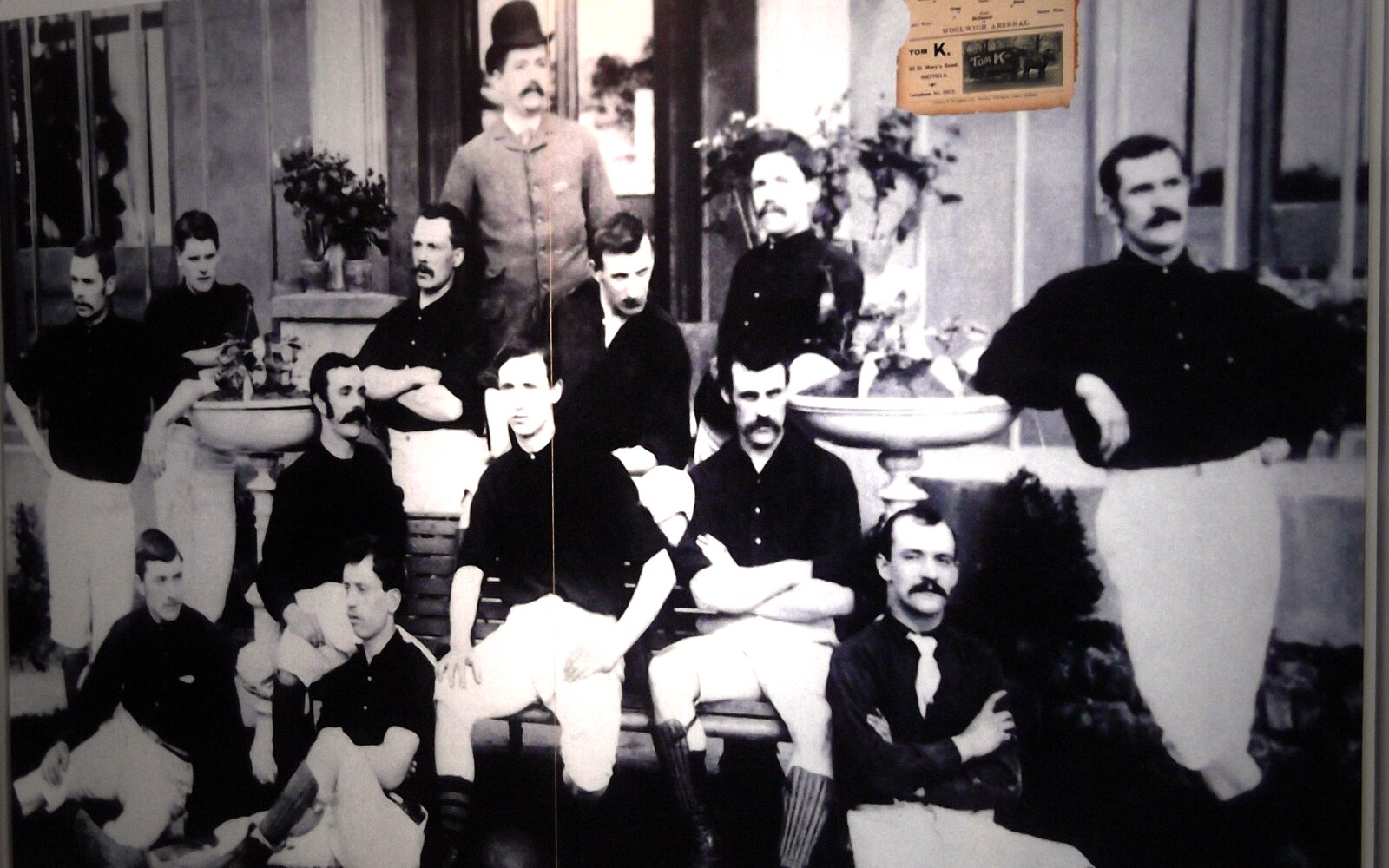
Arsenal began as Dial Square in 1886, formed by workers at the Woolwich armaments factory. The connection between that beginning and the club's red shirts is often compressed into a single act of generosity: Nottingham Forest supplied a set of shirts to a new team without the means to buy its own. It is an attractive explanation, giving the colour both a benefactor and a birthplace. But an archive should distinguish between a story that has been repeated and an event that can be established. Historical Football Kits explicitly records that research by Mark Andrews and Andy Kelly has cast doubt on the donation account.
What the research changes
The Forest connection does not disappear when the donation is questioned. Historical Football Kits identifies Fred Beardsley as a founder from Nottingham whose obituary credited him with suggesting Forest's colours. The Arsenal Collection's account likewise separates the adoption of red from the supposed gift of an entire strip. Its research points to Beardsley's obituary and a newspaper interview with fellow founder David Danskin as evidence that the players bought their red shirts. These are importantly different propositions. A former player's influence on a colour choice does not establish a shipment of clothing from his former club. Keeping the distinction visible preserves a connection without turning it into a transaction that the evidence does not support.
Reading a reconstruction
An early-shirt illustration can make uncertainty look deceptively complete. A collar, a shade of red and a row of buttons give an object the appearance of something recovered intact from the past. Yet the authority of an image depends on the evidence behind it, not on how convincingly it is rendered. The illustrated shirt accompanying this story should therefore be read as an interpretation, not as proof of the donation legend or an exact colour standard. The strongest historical point here is narrower: the club adopted red, and Beardsley's Nottingham background is part of the explanation recorded by the researchers. That is sufficient to make the shirt significant without asking it to certify every detail of the familiar tale.
A label that can change
There is a further reversal in The Arsenal Collection's research. For Nottingham Forest's centenary in 1965, Arsenal supplied shirts to Forest; the article supports that account with contemporary reporting and an extract from Arsenal's board minutes. That later gift should not be confused with evidence for an earlier one in the opposite direction. Instead, it demonstrates why dates and the direction of a transaction matter. The museum label for Arsenal's first red shirt is consequently a provisional one: a founding colour, a documented Nottingham connection, and a disputed donation. Acknowledging that uncertainty does not diminish the object. It makes room for the work of historians who ask what a cherished story actually rests upon.