The record in context
Thirty-eight, not forty-nine
An unbeaten season and an unbeaten run are related achievements, not interchangeable numbers. The Invincibles shirt sits at their intersection.
2003–04 · Highbury's Last Act · 3 minute read
The season's exact outline
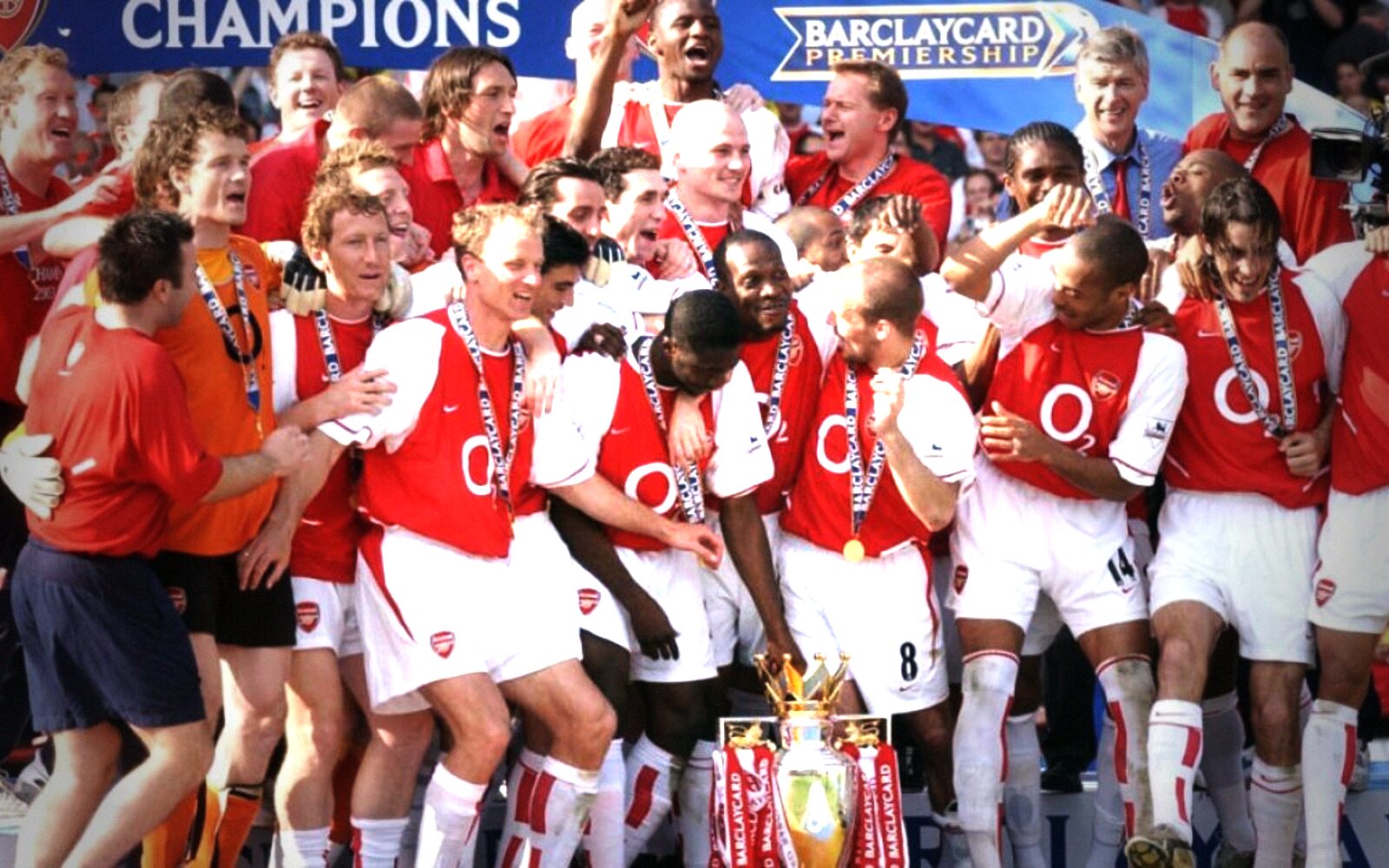
Arsenal completed the 2003–04 Premier League season without defeat: thirty-eight matches, twenty-six wins and twelve draws. Those are the figures given in the club's interview with goalkeeper Jens Lehmann, and they describe the achievement associated with the Invincibles name. The arithmetic is part of the history, not a decorative statistic to be rounded into a more general claim of invulnerability. The record concerns a league season. It does not say that Arsenal won every match, and it should not be extended casually to every competition. A museum label serves the achievement best by keeping its boundaries precise. The absence of league defeats is remarkable enough without making the claim larger than the evidence.
A longer line around it
The forty-nine-match unbeaten league run is a second, overlapping record. Arsenal's statistical account dates it from May 2003 to October 2004, spanning the end of one season, the whole of the next and the beginning of another. It began with victories over Southampton and Sunderland in 2002–03. The complete 2003–04 league programme sits within that sequence, rather than accounting for all of it. This is a useful distinction for a shirt archive because garments are commonly grouped by seasons, while sporting records do not always respect those divisions. A season label supplies one frame; an unbeaten run supplies another. Both are valid, but the numbers answer different questions.
Draws belong to the record
The twelve draws should remain visible beside the twenty-six victories. Arsenal's run statistics identify four goalless league matches during the unbeaten season, against Birmingham, Newcastle, Fulham and Manchester United. Those matches did not interrupt the record. They demonstrate why unbeaten is a specific description rather than a synonym for always winning. A shirt displayed only beside a list of famous victories would leave out part of the work that the final table records. The season's shape includes points shared as well as games won. This does not require an invented account of dressing-room resolve or a claim about how a particular draw felt. The results themselves establish that survival without defeat took more than one form.
An object with two timescales
Arsenal's statistical history records that the wider run ended with a 2–0 defeat at Manchester United in October 2004. That ending belongs to the run's story, not to the completed unbeaten season, whose status could no longer change. The distinction lets us read the Invincibles shirt at two timescales. It recalls the bounded achievement of 2003–04 and also occupies the middle of a sequence stretching beyond that campaign. Neither perspective cancels the other. Placed beside the results, the garment becomes more than an emblem attached to a round number. It marks a season whose exact dimensions can still be recovered: thirty-eight league fixtures, no defeats, and a place within forty-nine consecutive unbeaten league matches. The care lies in remembering which number belongs to which claim.