Design and identity
The invention of white sleeves
In 1933 a change to the sleeves made red and white into a recognisable arrangement, not merely a pair of colours.
1933 · The Chapman Legacy · 3 minute read
A change within red
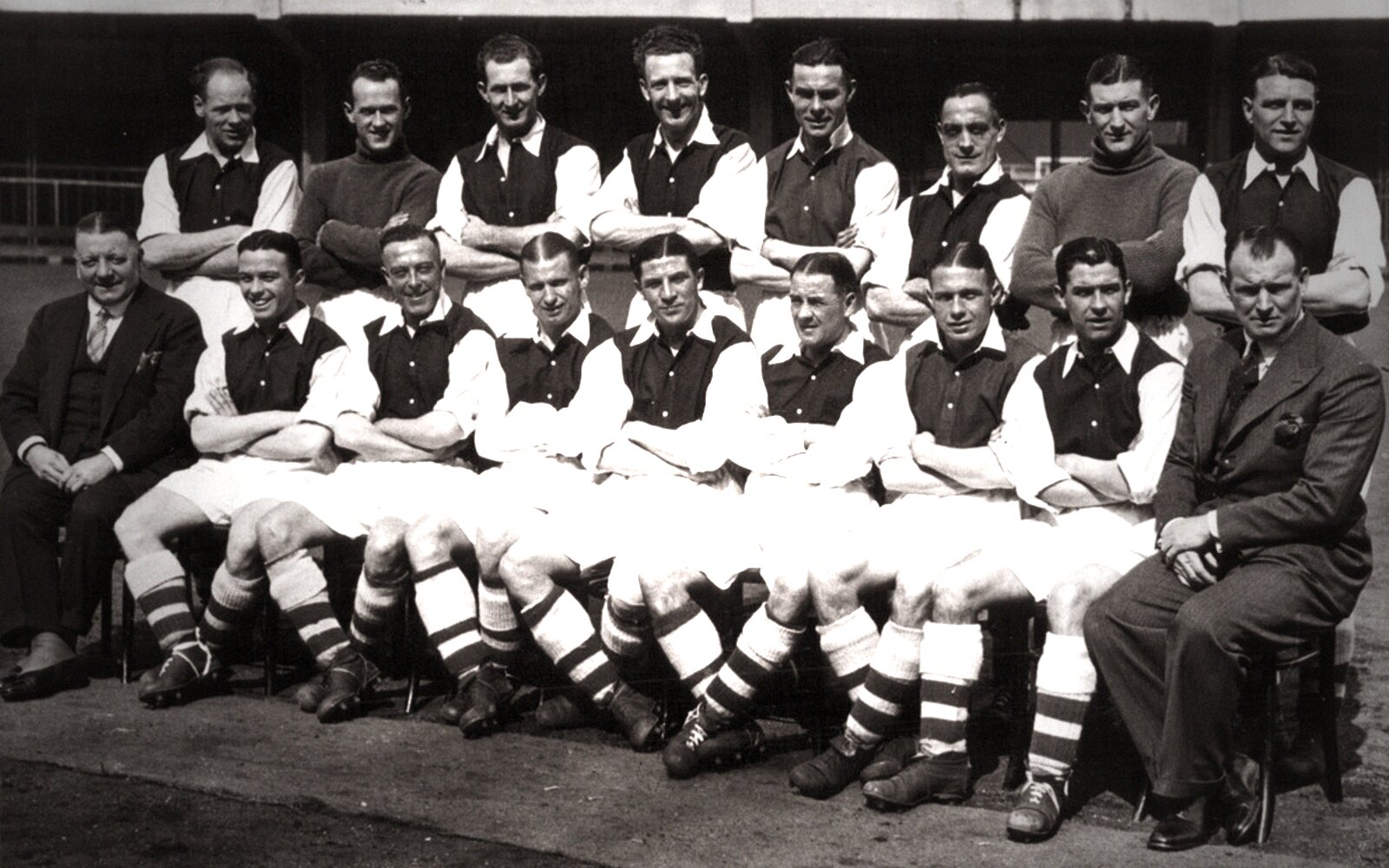
The defining feature of an Arsenal home shirt is not red alone. It is the relationship between a red body and contrasting white sleeves. Arsenal's own kit history attributes that arrangement to Herbert Chapman, the manager who arrived in 1925. The change is dated to 1933 in the club's heritage account and in the Historical Football Kits chronology. Seen across a long sequence of shirts, it is a remarkably economical intervention: the principal colour remains, while the edges of the garment become a second field. The result is a design that can be described in a few words even when the particular collar, badge or manufacturer changes.
Two accounts of an idea
The origin of the inspiration is less secure than the existence of the design. Arsenal's account offers two versions. In one, Chapman noticed somebody at the ground wearing a red sleeveless sweater over a white shirt. In the other, the relevant figure was the cartoonist Tom Webster, encountered while playing golf. Both stories explain the same visual arrangement through ordinary clothing rather than through another football strip. They should be presented as alternatives, not combined into a single scene. There is no need to choose a preferred anecdote to appreciate the resulting shirt. The arrangement itself is documented; the precise moment when Chapman first imagined it is a different kind of claim.
The shirt in the sequence
Historical Football Kits places the white-sleeved design in its March 1933 sequence. Arsenal's heritage range description identifies the home shirt associated with 1933 to 1957 and explains that Chapman added the contrasting sleeves to an earlier red shirt with a white collar. Together, these accounts help separate an enduring design principle from the changing details of individual garments. A white collar was not the whole innovation; it was the extension of white across the arms that altered the silhouette. This is why an archive needs more than a list of colours. Two shirts may both be described as red and white while distributing those colours in substantially different ways.
Continuity without a frozen template
To call the white sleeves a signature is not to claim that every later Arsenal home shirt repeated an unchanging template. The Historical Football Kits chronology is useful precisely because it records variations rather than reducing the club's wardrobe to a single ideal shirt. A museum can hold both ideas together: there is a recognisable convention, and there are departures, revisions and returns within its history. Chapman's contribution is best understood as a durable visual relationship rather than a pattern that no designer could alter. On the shirt shown here, the contrast asks for very little ornament. Red occupies the centre; white describes the arms. The importance lies in that division of space, and in how readily it allows one generation of shirts to be read alongside another. The uncertainty surrounding the inspiration should remain on the label, but it need not obscure the clarity of the design.