Achievement and memory
A Double in two colours
The first Double belongs to red and white, but its decisive Wembley image is yellow. One season needs more than one shirt.
1970–71 · Doubles & Finals · 3 minute read
Two parts of an achievement
Arsenal's first League and FA Cup Double was completed in 1971 under Bertie Mee. The league title was secured with a 1–0 victory at White Hart Lane; five days later the team faced Liverpool at Wembley. Arsenal's retrospective places those two matches together because neither alone accounts for the achievement. The Double is a conjunction: a championship earned across a season and a cup won through a separate competition. A shirt archive faces the same problem of joining things without making them identical. The familiar home colours belong to the season's story, but the cup final was played in yellow. One garment cannot stand literally for every stage.
Wembley, still unresolved
The final did not supply an immediate conclusion. Arsenal's account describes a goalless normal time before Steve Heighway put Liverpool ahead in extra time. Arsenal then equalised, with Eddie Kelly's touch central to an incident initially claimed by George Graham. The club's detailed Double retrospective notes that television pictures suggested Graham had not touched the ball on its way past Ray Clemence. That qualification is worth retaining. Even an achievement with such a familiar ending contains details that require careful attribution. A museum label should not smooth away the distinction between an initial claim and the later reading of the evidence simply because the match has become part of a settled commemorative story.
A yellow-shirted conclusion
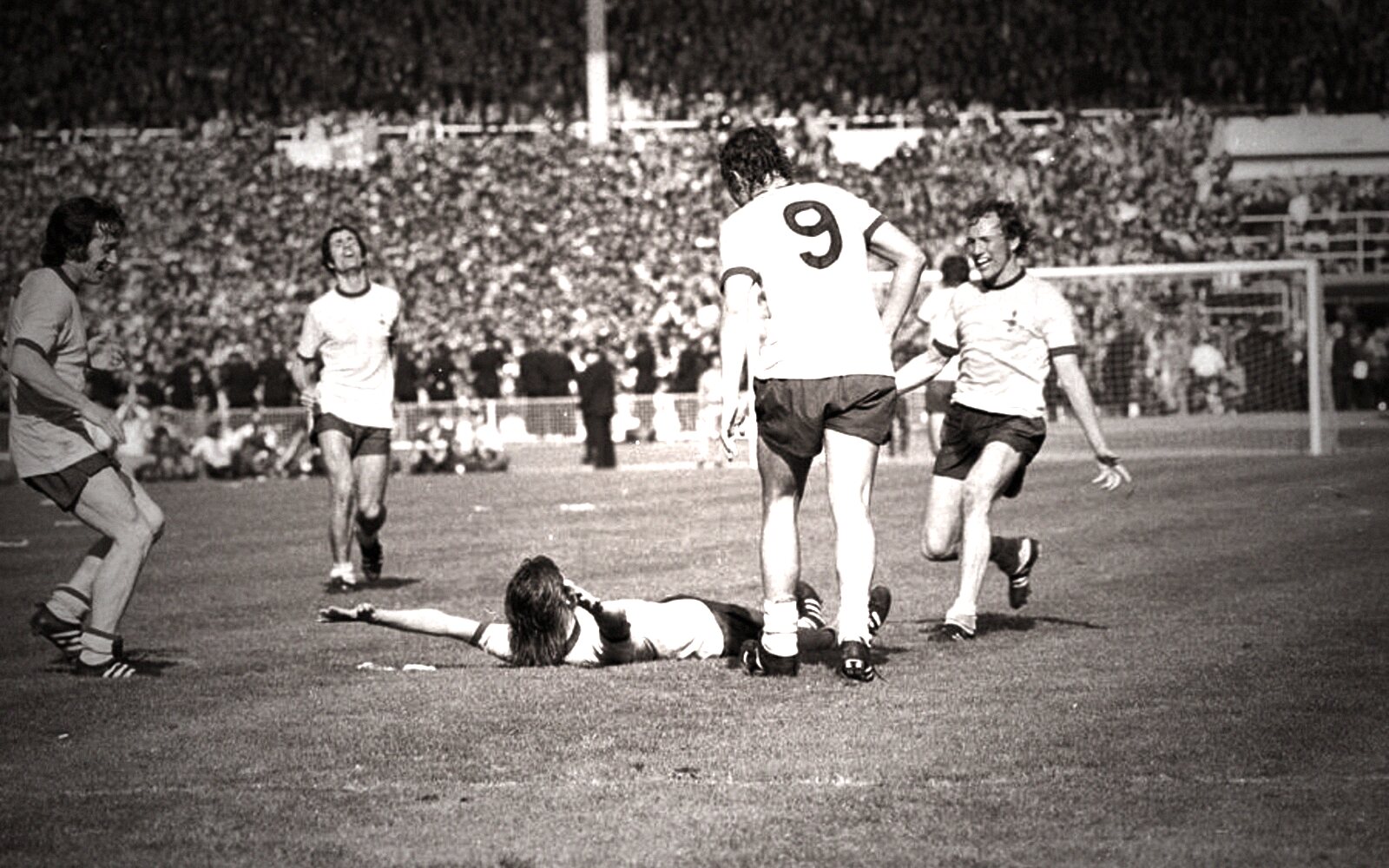
Charlie George supplied the winner. Arsenal's account of the goal describes John Radford's involvement before George drove his shot past Clemence, then lay on his back on the Wembley turf with his arms extended. The club's FA Cup history explicitly identifies the yellow jersey in which the trophy was won. Colour is therefore more than a decorative aside to the match report. In the surviving image of the celebration, it identifies the particular occasion within a much larger red-and-white history. The shirt's importance does not require a claim about how every supporter felt about it. Its place is established by the achievement and by the visible form in which that achievement was completed.
Bringing the trophies home
Arsenal later paraded both trophies at Highbury before the first home match of the 1971–72 season, against Chelsea. The club's account describes that occasion as a chance for the home crowd to share the previous season's success. It also records the long intervals since Arsenal's preceding league and FA Cup wins: eighteen and twenty-one years respectively. Those intervals give the Double a scale that the final whistle alone cannot convey. Displaying the yellow final shirt beside the home shirt offers a similarly useful perspective. They are not competing candidates for the title of the season's true shirt. They are complementary records, carrying different parts of the same achievement. The archive can let the final's yellow remain distinct while still placing it within the season that made the first Double possible.